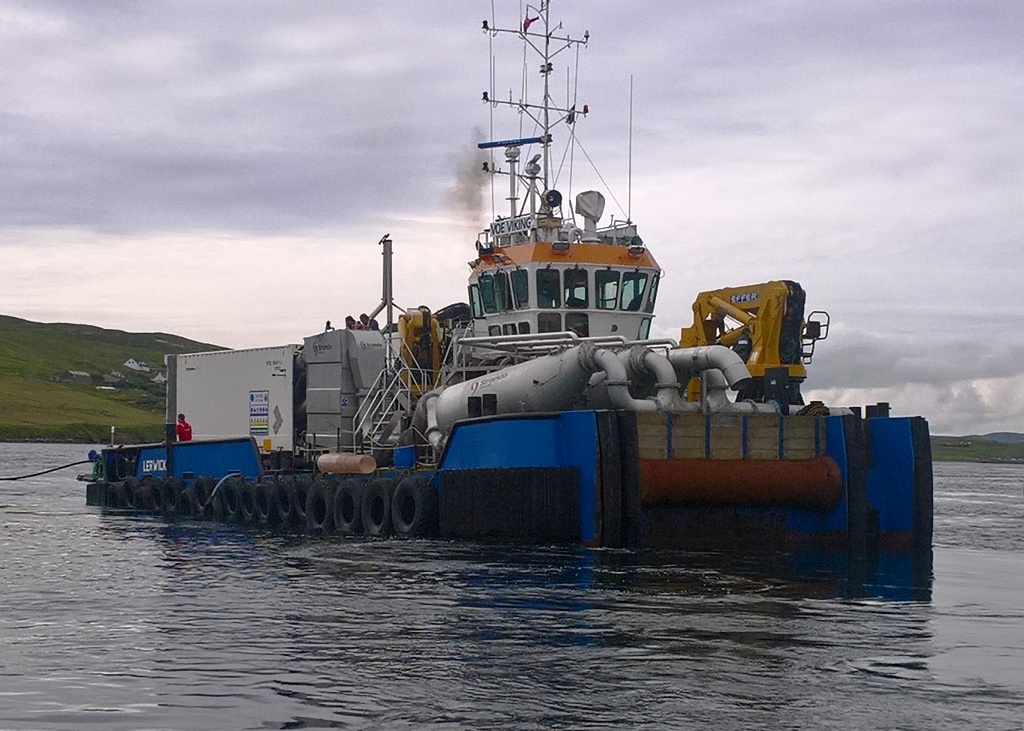
Our greatest failure to date was our campaign against an application to plant a huge industrial fish farm Port na Morachd, the lovely bay in the above image. Although there were over 800 objections the application was duly rubber-stamped by Argyll & Bute Council.
That process led to our greatest success to date, our complaint to the European Union, which led directly to a change in the law regarding the disposal of dead fish.
In the course of campaigning against the applications at Ardmaddy members of saveseilsound discovered that 82,663 mature salmon had perished at Ardmaddy over a few months, ending in December 2011.
The total waste created thereby was reported by the operators as 256 tonnes.
Ardmaddy is an extremely remote site, with no road access. Residents were alarmed at the possibility that this enormous quantity of waste might simply have been dumped at sea. Even worse, what if the dead fish had been recycled into fish food for fish farms?
We decided to find out and were astonished to discover that nobody in officialdom knew!
Argyll & Bute Council didn’t even know that this disaster had happened.
SEPA had learned some months after the event, when Lakeland Marine Farm sent in its mortality figures, but they hadn’t bothered to do anything.
Nobody outside of Lakeland knew the cause of death.
We then found that this was all entirely within the law as it then stood, because the UK had negotiated a special derogation from the Animal By-Products Waste Directive exempting almost the entire aquaculture coast from environmental protection.
The Directive was brought in after the BSE “mad cow” scare and of course at that the fish farming industry was much smaller than it is today.
Strictly this belonged to the field of public health and safety and we took our complaint to the section of the EU Commission in Brussels with specific responsibility for this.
The Complaint was lodged in April 2012 and we didn’t hear much until we got a message on 24 June 2015 as follows:
“Extensive correspondence has taken place between the Commission services and the UK authorities in the context of the EU Pilot investigation which was triggered by your complaint. I can inform you that the UK authorities have in this context presented an action plan which includes an envisaged amendment to the Animal By-Products (Enforcement) (Scotland) Regulations 2013 and improvements to the official control activities, in particular in relation to contingency planning for large scale fish mortality disposal. In order to maintain the necessary trust-based cooperation between the Member State and the Commission during the pending EU Pilot investigation, further details of the action plan submitted by the UK authorities cannot be explained at this stage. However, the timeline provided by the UK authorities shows, inter alia, that the legislative amendment is envisaged to enter into force by the end of year 2015. The Commission services are closely following up with the commitments of the UK authorities in this context.”
Success dressed up as failure
In April 2016 we learned that the law had now been changed, as we were told that the Complaint had been shut down on the basis that it was no longer necessary!
We hadn’t spotted that in late 2015 the Scottish Government had held a “public consultation” on the Animal Waste Regulations. This was plainly our fault, but it might have been courteous for the government to have informed us and given us the opportunity to comment. Instead the invited consultees were virtually all from the industry.
Among the options given was for the law to be left unchanged and in continuing breach of the EU Directive, which would have involved the UK constantly breaking the law and being fined. It’s odd that this was even considered, but it seems that a cost benefit analysis showed that it could be more expensive to pay the fines than to dispose of the waste safely.
And also a threat to health and safety maybe?
In the event the safe option was chosen and the new law came into effect in January 2016. As a result all waste has to be treated by a process called ensiling, basically the dead fish are put in a vat of formic acid which turns them into smelly slush that can be safely disposed of in landfill. Small amounts can be handled on site, while larger quantities are dealt with industrially.
Incredibly, there is still no supervision. As in all its operations the industry is self-policing and companies are trusted to behave.
We decided to find out who had taken part in the Consultation and what they had said. We sent a Freedom of Information Request to the Scottish Government and have now received copies of the consultation responses.
The majority of responses were from either local authorities or land-based industries. SSPO agreed that the law should be changed, as did Dawnfresh, who operate in Loch Etive. One of the currently operating companies, who insisted on their identity being withheld, sent the following gem:

So, this company were actually happy that the consequences of some catastrophic repeat of Ardmaddy in future would just be dumped on a local landfill site, whose workers and an unwitting local population would be left with the consequences!